Caiçara
Pending reviewNot yet checked by a community or historical reviewer.
Still to check: the Old Tupi origin of caiçara.
The palisade of sharpened trunks round a Tupinambá village, often in two rings, with narrow openings. Caiçara today also names the fishing communities of the southern coast.
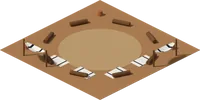
When enemies were near, a village was ringed with a fence of trunks set close together, and sometimes a second fence outside it. Hans Staden, who was held in such a village, describes the double palisade and the narrow ways in. Archers shot through the gaps, and stakes and pits made the approach harder.
The word caiçara, from Old Tupi, meant this fence. In Brazil it now names the traditional fishing people of the coast of São Paulo, Paraná and Rio de Janeiro.
In the game: from the second era you build palisades and gates. Your own people walk through a gate; enemies have to break it down.
 Oca
 Lookout tower
 Ocara
Sources
- Indigenous voiceCasé Angatu (Carlos José Ferreira dos Santos), Tupinambá historian and teacher, Olivença, writings on Tupinambá history and territory
- ResearchFlorestan Fernandes, A função social da guerra na sociedade tupinambá (1952)
- ResearchAlfred Métraux, La civilisation matérielle des tribus tupi-guarani (1928)
- Early European account, read with careHans Staden, Warhaftige Historia (1557)
- Early European account, read with careJean de Léry, Histoire d'un voyage faict en la terre du Brésil (1578)