Oca
Pending reviewNot yet checked by a community or historical reviewer.
Still to check: how many people a house held (accounts vary a lot) and the size of the houses.
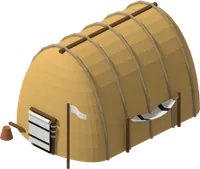
The great communal house of a Tupinambá village: a long hall of poles thatched with palm, home to many related families, each with its own hammocks and fire.
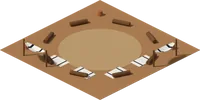
A Tupinambá village (taba) was a handful of these long houses set round the plaza. They were built of poles and beams tied with vines and covered with palm leaves down to the ground, with low doors at the ends. European visitors in the 1500s described houses long enough for dozens of hammocks.
Inside there were no walls: each family hung its hammocks between the posts along its own stretch of the house, and kept a small fire there for warmth and cooking. A house was usually home to a group of relatives, with a respected elder at its head.
In the game: the oca houses your people and takes in food, wood, clay and treasure. The stone axes are made here.

Sources
- Indigenous voiceTupinambá de Olivença community, Bahia (Terra Indígena Tupinambá de Olivença)
- Indigenous voiceKaká Werá Jecupé, A terra dos mil povos: história indígena do Brasil contada por um índio (1998)
- ResearchFlorestan Fernandes, A organização social dos Tupinambá (1949)
- ResearchCarlos Fausto, Os índios antes do Brasil (2000)
- Early European account, read with careJean de Léry, Histoire d'un voyage faict en la terre du Brésil (1578)
- Early European account, read with careHans Staden, Warhaftige Historia (1557)