Ocara
Pending reviewNot yet checked by a community or historical reviewer.
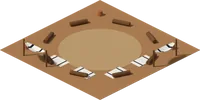
The open plaza at the heart of a Tupinambá village, ringed by the great houses: where the village met, talked, danced and feasted.
A Tupinambá village (taba) was a few great longhouses (oca) set round an open, swept plaza, the ocara. Councils of the elders and the morubixaba met there, guests were received there, and the great feasts and dances were held there.
Because the village moved every few years, the ocara moved too: a new site meant clearing a new plaza and raising the houses round it again.
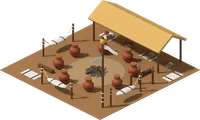
The village moved as its great houses wore out: a maloca of wood and palm thatch lasted three or four years, and the move came when the houses and the fields around them were spent (Documented: Florestan Fernandes, A economia tupinambá, 1949). In the game, Tupinambá villagers can also take their own buildings apart, in half the time it took to build them, for half of what they cost: that the houses were taken apart for their materials is the game's own (Game invention).
In the game: the ocara is your main building. Villagers are created there, the eras are reached there, and "Move the village" carries its fire to a new site. It takes everything your people gather. Losing it loses the match.

Sources
- Indigenous voiceTupinambá de Olivença community, Bahia (Terra Indígena Tupinambá de Olivença)
- ResearchFlorestan Fernandes, A organização social dos Tupinambá (1949)
- ResearchEduardo Viveiros de Castro, A inconstância da alma selvagem (2002)
- ResearchFlorestan Fernandes, A economia tupinambá (1949)
- Early European account, read with careJean de Léry, Histoire d'un voyage faict en la terre du Brésil (1578)