Roça
Pending reviewNot yet checked by a community or historical reviewer.
Still to check: the Old Tupi form ka'a pûera.
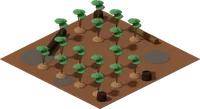
A field cleared and burned in the forest, where manioc was planted with maize, sweet potatoes, beans, peanuts and cotton. After a few years it was left to grow back into forest.
To make a roça the men felled the trees at the end of the dry season and burned them (the coivara); the ash fed the soil. The women planted and harvested, and they knew the many kinds of manioc. Bitter manioc is poisonous raw: it was grated, squeezed in the tipiti, a woven press, and roasted into flour (farinha) and flat breads (beiju).
After a few harvests the soil was tired, and the field was left to the forest. The regrowing woods are still called capoeira in Brazil, from the Tupi ka'a pûera, "what was forest". This rotation is one reason villages moved every few years.
In the game: the roça is your farm. Up to three people work it until it is spent; then it lies fallow for a while before it can be sown again.

Sources
- Indigenous voiceTupinambá de Olivença community, Bahia (Terra Indígena Tupinambá de Olivença)
- Indigenous voiceAilton Krenak, Ideias para adiar o fim do mundo (2019)
- ResearchCarlos Fausto, Os índios antes do Brasil (2000)
- ResearchEduardo Góes Neves, Sob os tempos do equinócio: oito mil anos de história na Amazônia central (2022)
- Early European account, read with careGabriel Soares de Sousa, Tratado descritivo do Brasil em 1587
- Early European account, read with careJean de Léry, Histoire d'un voyage faict en la terre du Brésil (1578)