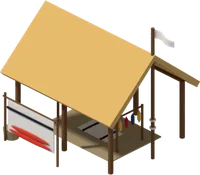
Featherworkers' house
Pending reviewNot yet checked by a community or historical reviewer.
Still to check: the name assojaba for the mantle, and which museum the 2024 mantle went to in Brazil (the National Museum in Rio).
Where feather work was made: headdresses, armbands and the great mantles of red guará feathers, worn by the most honoured people at the feasts.
Tupinambá feather work was famous in Europe from the 1500s on. The feathers of the scarlet ibis (guará), macaws, parrots and other birds were tied one by one onto a net of cotton thread to make mantles, headdresses and ornaments. A few mantles survived in European museums.
In 2024 one of them came home from the National Museum of Denmark to Brazil, and the Tupinambá of Olivença received it as an ancestor. Glicéria Tupinambá and other women have learned to make the mantles again, in dialogue with the old ones.
In the game: from the second era, up to three villagers make feather work and shell beads here. It gives treasure.


Sources
- Indigenous voiceGlicéria Tupinambá (Célia Tupinambá), artist and leader of the Tupinambá of Olivença, on remaking the feather mantles
- Indigenous voiceTupinambá de Olivença community, Bahia (Terra Indígena Tupinambá de Olivença)
- ResearchAlfred Métraux, La civilisation matérielle des tribus tupi-guarani (1928)
- ResearchCarlos Fausto, Os índios antes do Brasil (2000)
- Early European account, read with careJean de Léry, Histoire d'un voyage faict en la terre du Brésil (1578)
- Early European account, read with careAndré Thevet, Les singularitez de la France antarctique (1557)