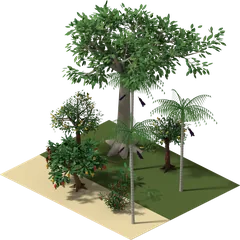
Dense and open forest
Pending reviewNot yet checked by a community or historical reviewer.
Still to check: Whether the forest's thickness and the restinga's openness are shown at a fair scale; the Anhangá as keeper of the game (colonial writers made it an evil spirit, which Tupi peoples do not).
The Atlantic Forest grows so thick that people keep to its trails; by the sea it opens into the restinga, lower woods on sand. In the game a dense forest is closed to people, but not to the forest's own beings.
Before 1500 the Atlantic Forest (Mata Atlântica) covered the coast of what is now Brazil from the northeast to the south: tall trees such as the jequitibá and the pau-brasil, palms like the juçara, and under them a tangle of shrubs, lianas and young trees. People crossed it on paths they kept open, along the rivers and the shore.
Near the sea, on sandy ground, grow the restinga woods: lower and more open, with cashew, pitanga and palms. The Tupinambá cleared small fields in the forest (roças), let them grow back and moved on, so the forest round a village was a patchwork of old and young growth.
In Tupi stories the forest has its keepers. The Curupira, whose feet point backwards, and the Caipora look after the animals and the trees and lead astray those who take too much; the Anhangá guards the game.
In the game: on the coast the forests inland are dense (no one gets through the undergrowth, so woodcutters work their edges) and the woods by the beach are open, with room to walk between the trunks. In the river valley the forest is dense along the rivers. The Curupira, the Caipora and the Anhangá walk through any forest.


Sources
- Indigenous voiceCasé Angatu (Carlos José Ferreira dos Santos), Tupinambá historian and teacher, Olivença, writings on Tupinambá history and territory
- Indigenous voiceTupinambá de Olivença community, Bahia (Terra Indígena Tupinambá de Olivença)
- ResearchWarren Dean, With Broadax and Firebrand: The Destruction of the Brazilian Atlantic Forest (1995)
- ResearchLuís da Câmara Cascudo, Geografia dos mitos brasileiros (1947)
- Heritage recordFundação SOS Mata Atlântica and INPE, Atlas dos remanescentes florestais da Mata Atlântica
- Early European account, read with careJean de Léry, Histoire d'un voyage faict en la terre du Brésil (1578)