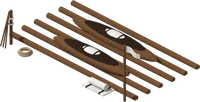
Canoe landing
Pending reviewNot yet checked by a community or historical reviewer.
Still to check: Staden's numbers for the canoes, and the Old Tupi words ygara and piperi.
The shore where the village kept its canoes and brought in the catch. The Tupinambá were people of the coast and the rivers, at home on the water.
Canoes (ygara in Old Tupi) were made from a single great tree, hollowed out with fire and stone tools, or from the bark of a tree, shaped and tied. Hans Staden, a prisoner among the Tupinambá in the 1550s, writes of bark canoes big enough for about thirty people.
From the landing men went out to fish at sea, in the bays and in the rivers, with nets, lines, traps and arrows, and on rafts (piperi) as well as in canoes.
In the game: the port. Up to three people fish here from the shore and fishing canoes bring their catch; it trains fishing canoes and, from the second era, canoe warriors. Swift canoes are learned here.


Sources
- Indigenous voiceTupinambá de Olivença community, Bahia (Terra Indígena Tupinambá de Olivença)
- ResearchAlfred Métraux, La civilisation matérielle des tribus tupi-guarani (1928)
- ResearchEduardo de Almeida Navarro, Dicionário de tupi antigo (2013)
- Early European account, read with careHans Staden, Warhaftige Historia (1557)
- Early European account, read with careGabriel Soares de Sousa, Tratado descritivo do Brasil em 1587