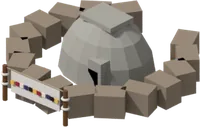
Huaca
Pending reviewNot yet checked by a community or historical reviewer.
Still to check: the number of huacas in the ceque system (Cobo lists about 328).
A huaca is anything sacred: a rock, a spring, a mountain, a shrine or an ancestor. Offerings of chicha, coca, cloth and food were made to them, and still are.
Around Cusco alone, hundreds of huacas were set along lines (ceques) running out from the Temple of the Sun, each looked after by an ayllu. A huaca could speak, protect, punish or heal. People brought it coca leaves, maize beer, fine cloth, small figures and, on great occasions, llamas.
In the Andes today offerings to the mountains (apus) and to Pachamama are made by families and by ritual specialists. Healers (hampiq) work with herbs and coca, and read the leaves.
In the game: from the third era, a sacred rock. It trains the hampiq, and up to six hampiq and runa make offerings here and earn Favour, faster than at the Temple of the Sun.

Sources
- Indigenous voiceThe Huarochirí manuscript, written in Quechua (c. 1608)
- Indigenous voiceQuechua communities of the southern Andes today
- ResearchBrian S. Bauer, The Sacred Landscape of the Inca: The Cusco Ceque System (1998)
- ResearchCatherine J. Allen, The Hold Life Has: Coca and Cultural Identity in an Andean Community (1988)
- Early European account, read with careBernabé Cobo, Historia del Nuevo Mundo (1653)