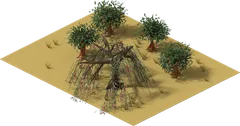
The highland woods
Pending reviewNot yet checked by a community or historical reviewer.
Still to check: How much of the highlands was wooded under the Inca is debated: pollen records suggest the queñua woods were wider before people and their herds.
High in the Andes trees are few: open woods of queñua grow up to the edge of the puna, and molle in the warmer valleys. In the game the Andes have open woods only.
The queñua (Polylepis) grows higher than almost any other tree on Earth, in small open woods on rocky slopes far above the valleys, its red papery bark keeping out the cold. Lower down, in the warm valleys between the ranges, grows the molle (Schinus molle), the pepper tree.
Andean peoples used both: queñua for fuel and building, molle for its wood, its berries (for chicha and dye) and as a medicine. The woods left today are what centuries of cutting and grazing have spared, and Quechua communities plant queñua again every year at the Queuña Raymi.
In the game: the Andes have open woods only, so people walk between the trunks; queñua high up, molle lower down.
Sources
- Indigenous voiceQuechua communities of Cusco and the Queuña Raymi, the yearly festival of planting queñua (with Asociación Ecosistemas Andinos, ECOAN)
- ResearchJon Fjeldså and Michael Kessler, Conserving the biological diversity of Polylepis woodlands of the highlands of Peru and Bolivia (1996)
- Early European account, read with careBernabé Cobo, Historia del Nuevo Mundo (1653), on the molle and the queñua
- Early European account, read with careGarcilaso de la Vega, Comentarios Reales de los Incas (1609), on the molle